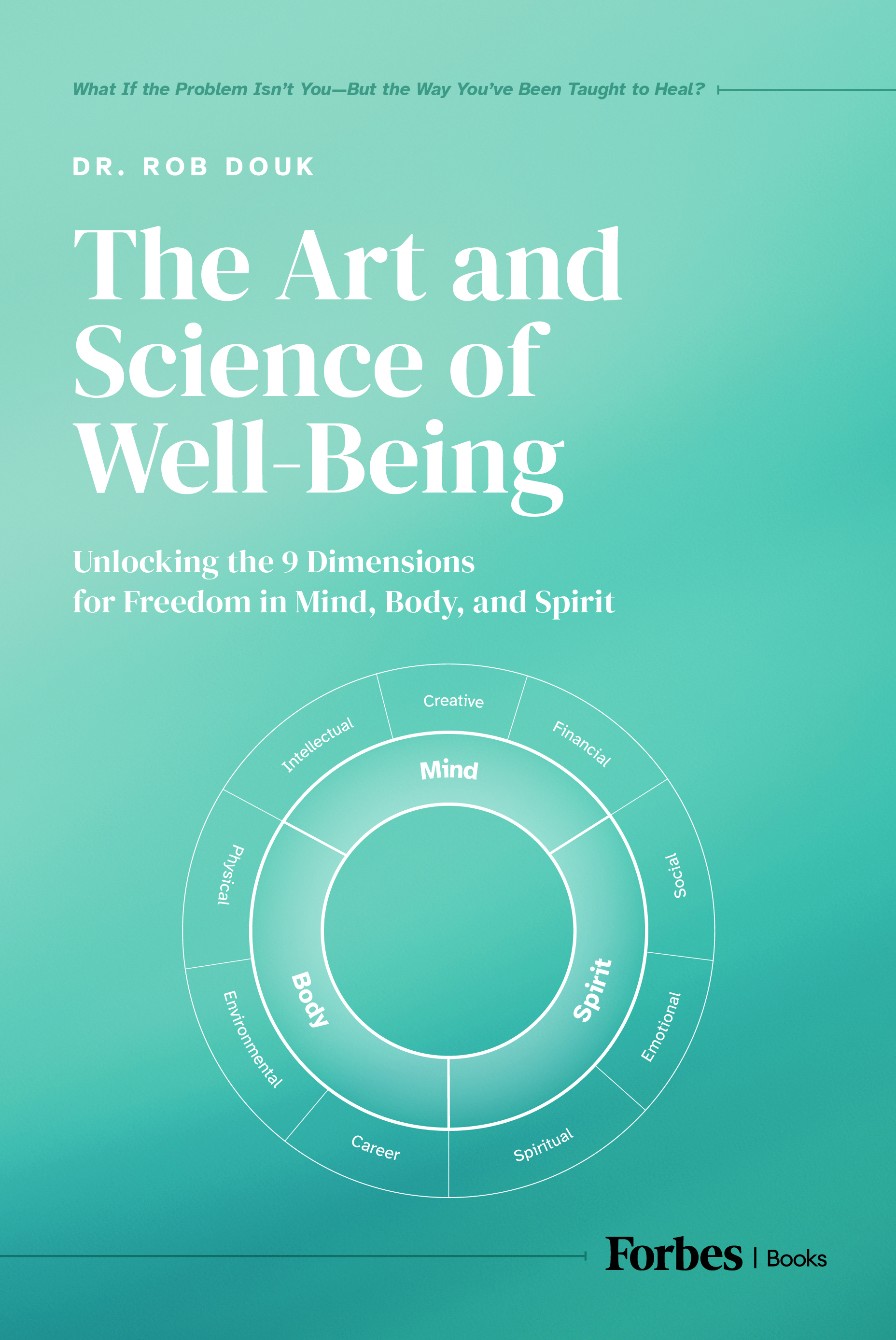
Dr. Rob Douk’s The Art and Science of Well-Being
presents a transformative holistic framework called “neurobiotheology”, which
integrates neuroscience, behavioral psychology, and spiritual intelligence to
redefine wellness as wholeness rather than perfection. Organized around nine
dimensions across three realms (mind: intellectual, creative, financial; body:
occupational, physical, environmental; spirit: spiritual, emotional, social),
the book refines Douk's extraordinary personal journey, from infant refugee
fleeing Cambodia’s killing fields to Harvard-trained psychologist and
entrepreneur experiencing burnout, and this journey creates the backbone and
lived proof of his methodology. Each chapter explores scientific research
supporting wellness practices while offering practical tools, such as the “Five
R's” for emotional regulation and the ‘Well Method” (knowledge, choice, belief,
habit, freedom) for sustainable transformation.
What distinguishes this work is its courageous integration
of empirical science with spiritual depth, without giving either more
importance than the other. Dr. Rob Douk fascinated me with his storytelling,
and I marveled at the lessons he draws from his personal experience. He has
that uncanny ability to deliver experiences and examples that are relevant and
resonant. It was thought-provoking and enjoyable to discover how he reframes
wellness not as self-optimization but as surrender, the art of releasing the
trauma-driven need for control that many high achievers carry in them. The
concept of “liminal space” examines the transitional periods where growth
occurs between identities. Particularly compelling is his argument that true
well-being emerges only when mind, body, and spirit function as an integrated
whole, supported by research on neuroplasticity, epigenetics, and myokines
(exercise-induced ''hope molecules''). The book's unique contribution
lies in dismantling the false dichotomy between faith and science: “If God is
the author of all things, then he is also the author of science.” This is
wellness literature at its most human: scientifically rigorous yet spiritually
generous, acknowledging that we heal not by perfecting ourselves but by
belonging to something greater. The Art and Science of Well-Being challenged
me to seek balance in a completely new way; it is not easy, but it gives you
what you need for work on you that truly matters.




 Mommys_Boy_6x9.jpg)


.jpg)






















.jpg)

.jpg)

.jpg)




.jpg)
.jpg)








.jpg)



 (2).jpg)

.jpg)









.jpg)



.jpg)



.jpg)







.jpeg)


.png)

 (1).jpg)

.jpg)



.jpg)