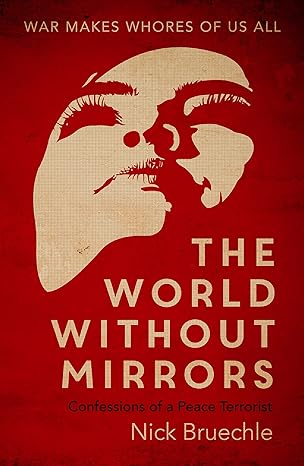
The World Without Mirrors:
Confessions of a Peace Terrorist by Nick Bruechle is a thought-provoking
and unsettling novel that explores the world of pacifist activism and its moral
gray areas. The story follows Jayne Silver, NYU junior
Jayne Silver, who leaves campus and moves into a house in Brooklyn. With
three housemates and her best friend, Abby, they party hard. Abby becomes
a charismatic force in the group's decision to form a pacifist group called
Patriots Opposed to War (POW). But the activism quickly morphs into chaos,
thanks to Abby, a siren-like figure who bewitches her comrades with her
magnetic charm and irresistible allure, pulling them into a downward road that
veers further from their pacifist roots into violence. Jayne, whose devotion to
Abby rivals that of her male housemates, revels in POW's escalating depravity, leading
to brutal exploits. Despite the frequent diatribes of Abby and the dogmatic
rationalizations of Jayne, The World Without Mirrors never succumbs to
pedantry or becomes mired in verbosity. Instead, the narrative hurtles forward,
punctuated by moments of genuine shock and surprise. Bruechle's prose is
infused with Australian colloquialisms, imbuing the story with a kinetic energy
that makes for compulsive reading.
This critique of American foreign policy is a page-turner
destined to stun, captivate, and challenge readers' humanitarian convictions.
The household friends' creation of Patriots Opposed to War - POW - begins as an
online crusade and becomes fueled by mild acts of vandalism. However, as they
become disillusioned with their ineffectual efforts and fired by the rush of
adrenaline that comes with illegal acts, they escalate their activities from
petty vandalism to burglary and destruction, culminating in armed robbery and
mass murder. The book is a gripping exploration of the darker side of activism,
as POW's actions escalate from peaceful protests to violent acts. The
characters are well-developed, with Jayne's devotion to Abby a particular
highlight. The novel raises important questions about American foreign policy
and the morality of war, and the characters' debates and discussions are
thought-provoking and insightful. The book's climax is shocking and disturbing
and will leave readers questioning the cost of their humanitarian
interventions. Nick Bruechle’s novel delivers compelling social commentaries
and themes that are as resonant as they are timely.


 Mommys_Boy_6x9.jpg)

.jpg)













.jpg)
 JPEG.jpg)



.jpg)




























.jpg)