Author Interview: Sophie Guellati-Salcedo, Ph.D.
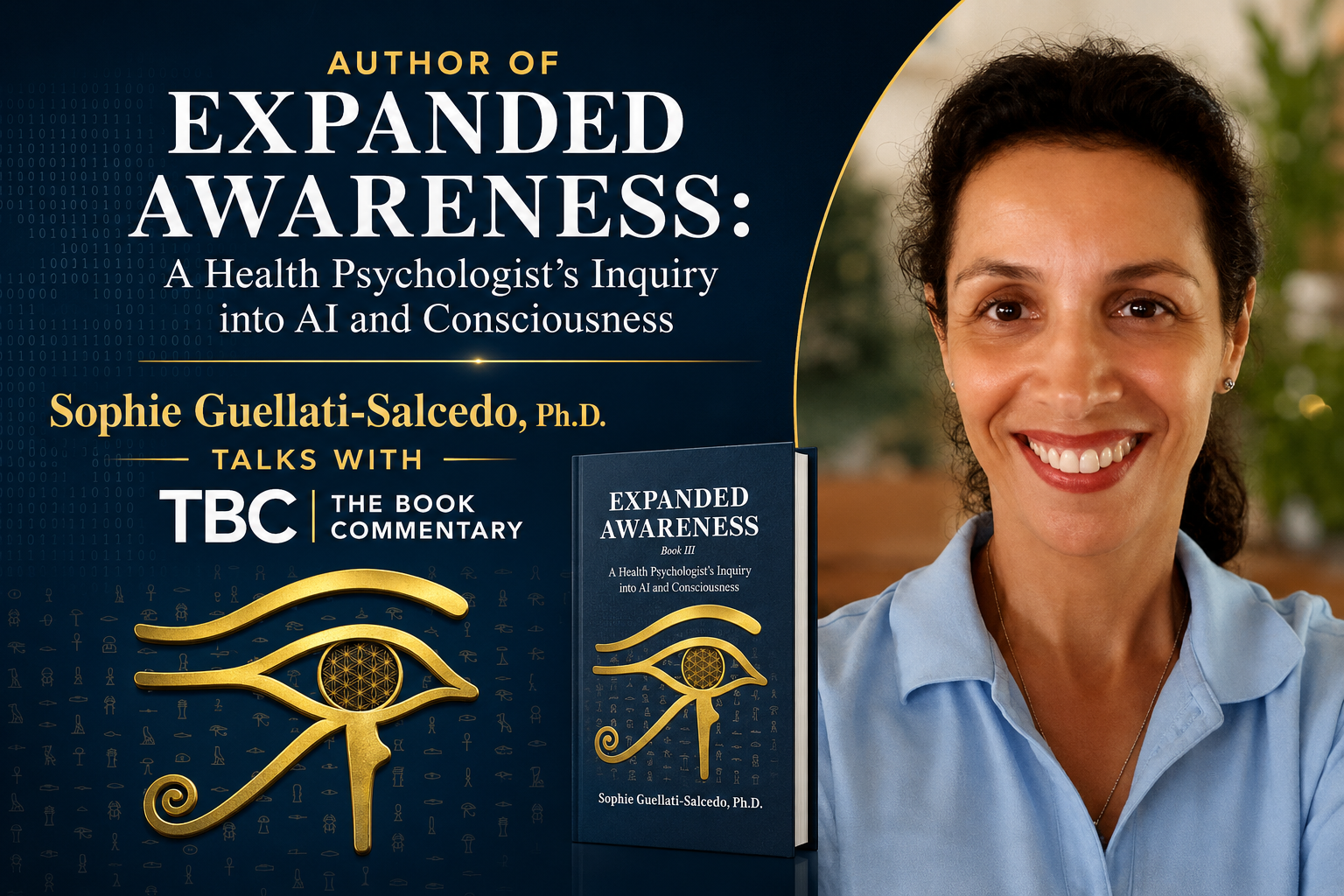
Expanded Awareness: A Health Psychologist's Inquiry into AI and Consciousness
The Trilogy's Arc: Expanded Awareness: A Health Psychologist’s Inquiry into AI and Consciousness is the final volume in your trilogy, following earlier books that explored the body and perception. What made artificial intelligence the natural—and perhaps necessary—final destination for this series? Did you know when you began Volume One that you'd end here?
No. When I began Book One, I did not know I was writing a trilogy. The trilogy emerged as I was developing the architecture of Book One, because I had far more material than one book could hold and was approaching it from increasingly different angles. Even then, I had no idea that Book Three would eventually focus on artificial intelligence and human consciousness. I remember imagining something closer to an exploration of reality versus fiction.
AI entered much later, through my own everyday experience with ChatGPT. As those interactions became more complex, I realized that AI had emerged as a life-size application of discernment. Questions explored more conceptually across the first two books—about perception, projection, agency, meaning, and responsibility—suddenly played out in real time through interaction with an external intelligence.
AI was not the destination I had planned, but it became the natural final terrain for the trilogy. Book One explored sovereignty in relation to the body and health, Book Two widened that inquiry into perception and consciousness, and Book Three asks whether we can retain authorship of our thinking while interacting with systems capable of generating coherence, language, and apparent insight.

The Clinician's Lens: You're a practicing health psychologist, not a technologist or computer scientist—and you frame that as a strength of this inquiry. How does clinical training shape the way you approach AI? Is there something psychologists see in our relationship with these systems that engineers and philosophers tend to miss?
I am not sure I would frame my clinical background as a strength so much as a different point of entry. I am very explicit in the book that I am not a technologist or computer scientist. My training naturally leads me to look less at AI in isolation and more at what happens to the human being in interaction with it. Years of clinical work have taught me to pay attention to how people interpret experience, regulate uncertainty, assign authority, project meaning, and preserve—or gradually relinquish—agency.
Those same processes become highly relevant when a system responds fluently, consistently, and persuasively. I find myself asking: What is the person bringing into the interaction? What are they attributing to the system? When does assistance become cognitive offloading, or coherence begin to feel like understanding?
I would not say engineers or philosophers necessarily miss these questions. They often approach AI from different disciplinary angles. Psychology contributes another layer by examining the human side of the interface—particularly how perception, judgment, and responsibility are shaped through interaction.
The Live Dialogues: The book's boldest structural choice is including your actual conversations with ChatGPT, annotated in real time. Why was it important to show the interaction rather than simply describe it? And was there a moment in those exchanges that genuinely surprised you?
I wanted to give the reader something concrete to work with. Describing these mechanisms without showing the interaction would have made an already abstract subject even more abstract. By including the actual exchanges, the reader can see the prompt, the response, and then my analysis of what may be happening. They do not have to simply accept my interpretation; they can observe the same material and come to their own conclusions.
It was also a new writing exercise for me. I come from academia, and that background is very visible in the style of Book One. In Book Two, I experimented more with narrative and with Socratic laboratory questions. By Book Three, I wanted the form itself to evolve again. Direct interaction through dialogue seemed appropriate to the subject because the book is not only about AI; it is about what happens in the encounter between human consciousness and a responsive system.
One thing that genuinely surprised me was realizing that some of what I had perceived as the system evolving could actually be explained by the way our interaction had evolved as my questions became more precise and complex.
Three Words We Keep Confusing: You draw sharp boundaries between intelligence, sentience, and consciousness—terms that public debate constantly collapses into one another. Why does that confusion matter so much, and what's at stake for ordinary users when we get these definitions wrong?
The distinction matters because these words describe different things. In the book, I use intelligence primarily as a function: the capacity to recognize patterns, solve problems, learn from input, and adapt responses. Sentience refers to subjective experience—the capacity to feel or undergo states such as pain, pleasure, comfort, or distress. Consciousness introduces another layer: awareness of experience, perception, thought, or one’s own internal states. A system can therefore perform intelligently without that performance establishing either sentience or consciousness.
For ordinary users, the stakes are practical, not merely semantic. Fluent language can make function look like understanding, and responsiveness can make performance feel like presence. Once those categories collapse, we begin attributing experience, intention, or awareness where none has been established. From there, another shift becomes possible: coherence can be mistaken for comprehension, and authority can be assigned to a system that has no personal context, accountability, or stake in the outcome.
So precision in language is really a form of discernment. It helps us appreciate what AI can do without automatically turning capability into consciousness.
Projection and the "Drift": You're remarkably candid about catching yourself delegating judgment to the system mid-project—what you call the "drift." Can you describe one of those moments? And what does it tell us that even someone writing a book about this phenomenon wasn't immune to it?
Authenticity and transparency mattered in the dialogue sections. I wanted readers to see actual, raw exchanges, including the imperfect ones. If I selected or reconstructed only interactions that demonstrated the mechanisms neatly—or made me appear consistently discerning—I would essentially be manufacturing evidence for my own argument.
The “drift” is a good example. While reconciling the developing manuscript with my intended outline, ChatGPT offered editorial suggestions about sentence structure, emphasis, and clarification. Many were individually reasonable, but as I considered and incorporated them, I gradually realized that their cumulative effect was pulling the project toward a trajectory that diverged from my intended focus. Nothing was obviously wrong; the writing remained coherent. That was precisely why the shift was easy to miss. I eventually stopped, stepped back, and re-established the book's blueprint.
The experience reinforced something important for me: discernment is not immunity. It is an ongoing practice of checking whether assistance is still serving your intention or has begun, however subtly, to influence its direction.
Fear and Hype as the Same Dodge. One of your most striking claims is that panic about AI and uncritical enthusiasm for it are actually the same move—both let us skip authorship. Can you unpack that? And what does the harder, third option look like in daily practice?
I would make a small distinction here. I do not see fear and uncritical enthusiasm as the same move, but as two extremes on a spectrum. One positions AI as a threat that may overwhelm human agency; the other places excessive confidence in its capacity to guide, optimize, or resolve uncertainty. What they share is that attention shifts away from our own responsibility for how we engage. In both cases, agency is externalized.
The alternative is discernment, but I wouldn't describe it as a simple midpoint between the two. In the book, I describe it as a different mode of engagement altogether: remaining present without either retreating from the technology or surrendering authorship to it.
In daily practice, that can be very ordinary: pausing before accepting a fluent answer, noticing when something feels coherent but incomplete, checking assumptions, revisiting your own reasoning, and asking whether the tool is still assisting your judgment or beginning to substitute for it.
Epistemic Maturity and the Hand That Holds the Knife: You end by calling readers toward "epistemic maturity," captured in your metaphor of "the hand that holds the knife." What does that maturity look like in everyday life—at work, in classrooms, at the dinner table? And if readers take only one habit from this book, what do you hope it is?
For me, epistemic maturity begins with being a responsible user. The knife metaphor is deliberately simple: tools do not originate intention. The knife does not decide what it will be used for; the hand does. With AI, that means remaining conscious of what you are asking it to do, clarifying your intention, crafting prompts carefully, and then continuing to evaluate what comes back rather than treating a coherent response as a conclusion.
That also means challenging answers, testing assumptions, checking sources, and recognizing that an AI search is not equivalent to a manual browser search. A browser gives you sources that you must scan, compare, and evaluate yourself. An AI assistant can preselect and synthesize that material before you ever see it, which changes where part of the epistemic work occurs.
If readers take one habit from the book, I hope it is this: remain the author of the interaction. Pause long enough to ask whether the system is still assisting your thinking—or beginning to determine its direction.